- Home
- Programs
- Democracy Research
Democracy Research


Researching Democratic History, Understanding Democracy Today
The Korea Democracy Foundation conducts research to deepen understanding of Korea's democratization movement and to explore the changing conditions and challenges of democracy today.
KDF approaches democratic history not simply as a record of the past, but as a source of knowledge for understanding the present and imagining the future. Through historical research, scholarly publications, the systematic development of democratic knowledge, academic exchange, and collaboration with researchers and institutions, KDF works to preserve the intellectual legacy of Korea's democratization movement while expanding research on democracy in Korea and beyond.
Our research connects history with the present, records with scholarship, and Korea's democratic experience with wider debates on democracy around the world.
Research on Korea's Democratization Movement
KDF conducts and supports research on the history of Korea's democratization movement, examining the events, organizations, individuals, ideas, and social forces that contributed to democratic change.
Research extends beyond major political events to explore the diverse experiences that shaped Korea's democratic history, including civic and social movements, resistance to authoritarian rule, state violence and human rights, political institutions, and the development of civil society.
By working with historical records and new research, KDF seeks to develop a richer and more comprehensive understanding of Korea's democratization and to make that knowledge accessible to researchers and the wider public.
Historical Dictionary of the Korean Democratization Movement
Building a Knowledge Base for Korea's Democratic History
The Historical Dictionary of the Korean Democratization Movement is one of KDF's major long-term research initiatives.
Launched online in 2023, the Dictionary systematically documents the events and organizations that shaped Korea's democratization movement. Entries are researched and written by scholars and specialists and are continuously expanded as research progresses.
The project combines scholarly research with historical records, photographs, audiovisual materials, maps, and other resources, creating a digital knowledge platform through which users can explore Korea's democratic history by period, subject, and place.
In 2026, KDF added 23 new entries covering major resistance movements and state repression during the period of Emergency Measures Nos. 4, 7, and 9 under the Yushin regime. These include the March 1 Declaration for Democracy and National Salvation, the Free Press Movement, and student democracy movements of 1975.
Through its continuing expansion, the Dictionary aims to build a systematic and accessible body of knowledge about Korea's democratization movement for researchers, educators, students, and future generations.
Journal of ‘Memory & Vision’
Connecting the Study of Democratic History with the Challenges of Democracy Today
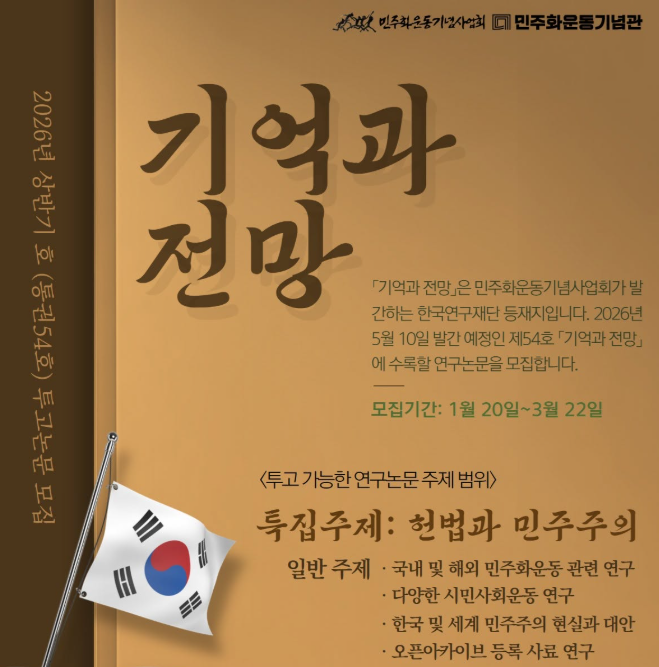
Published by KDF since 2002, the Journal of ‘Memory & Vision’ is a peer-reviewed academic journal listed in the Korea Citation Index (KCI).
Published twice a year, the journal provides a scholarly forum for research on democratization movements in Korea and abroad, the history and development of democracy, civil society, democratic institutions, and contemporary challenges facing democratic politics. It welcomes contributions from history, political science, sociology, and other disciplines, as well as interdisciplinary research.
The journal connects historical inquiry with contemporary democratic debate. Recent issues have examined the democratization movements of the 1980s as well as questions arising from Korea's recent experience of martial law and presidential impeachment, including constitutional democracy and the challenges facing democracy after political crisis.
Through Memory & Vision, KDF provides a continuing space where scholars can revisit Korea's democratic experience while engaging with emerging questions about democracy in Korea and around the world.
Academic Dialogue and Research Networks
Research becomes more meaningful when knowledge is shared and debated.
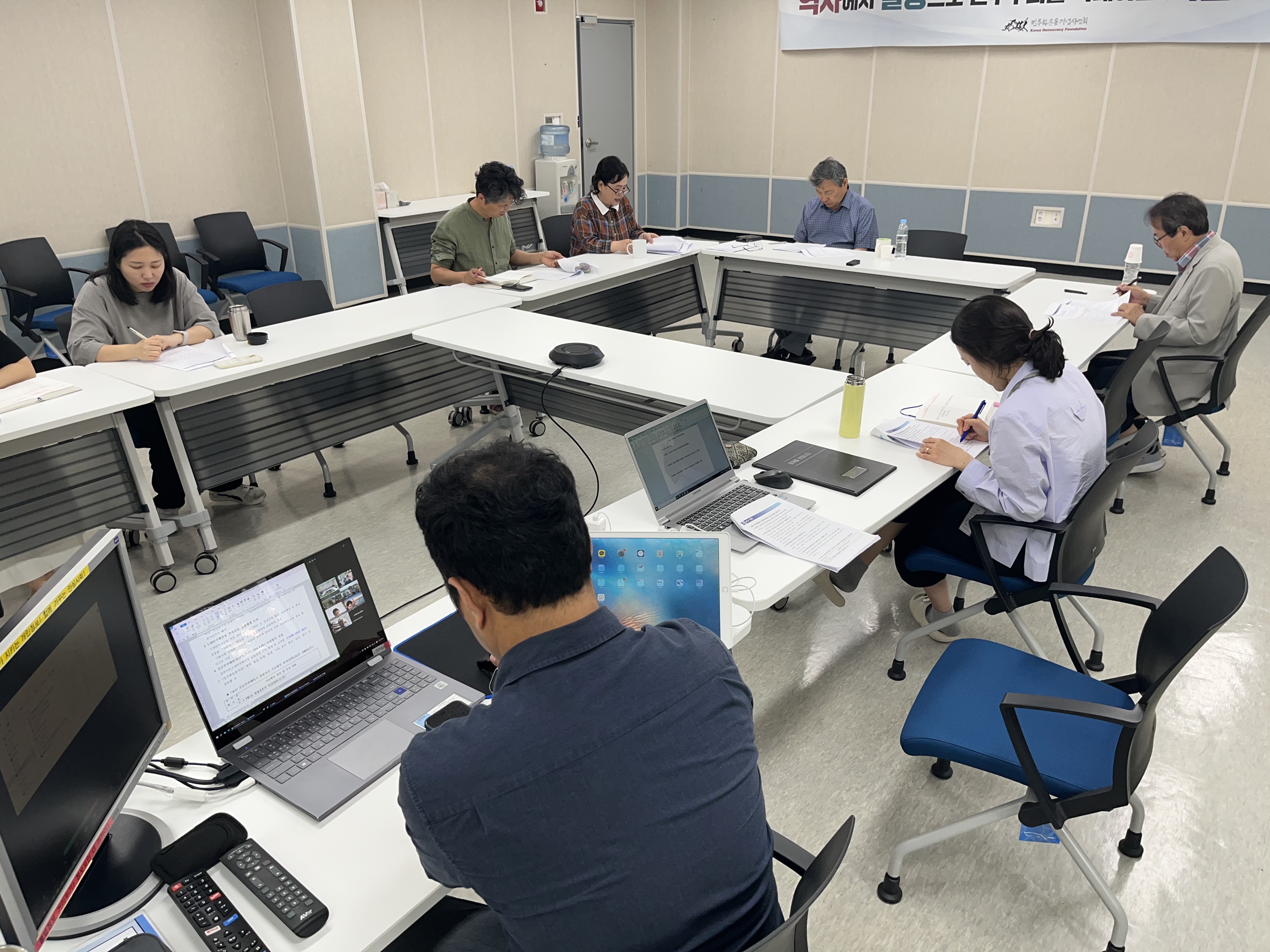
KDF organizes and supports academic conferences, colloquia, seminars, and research networks that bring together scholars and practitioners working on democratization, democracy, civil society, human rights, and related fields.
These forums provide opportunities to present new research, reinterpret historical events and records, and connect scholarship on Korea's democratization experience with comparative and international perspectives.
KDF also works to strengthen connections among researchers, universities, research institutes, archives, museums, and democracy organizations in Korea and abroad, creating opportunities for collaborative research and intellectual exchange.
From Democratic History to Democratic Knowledge
For KDF, research is part of a larger process of preserving and sharing democratic memory.
Historical records collected and preserved by KDF provide sources for new scholarship. Research, in turn, contributes to the Dictionary of the Korean Democratization Movement, academic publications, exhibitions, education, and public programs.
This creates a continuing cycle:
Records → Research → Knowledge → Education → Public Dialogue
Through this work, KDF seeks not only to document how democracy was achieved, but also to create knowledge that helps us understand how democracy changes, how it can be challenged, and how it can be sustained for future generations.